

The main legislations governing the chemical market in China is Order No. 12 of the Ministry of Ecology and Environment (MEE), Measures for the Environmental Management Registration of New Chemical Substances, also known as MEE Order No.12. This regulation came into force on 1 January 2021 and the previous regulation (MEP Order No.7) was simultaneously repealed.
In 2003, the former State Environmental Protection Administration (SEPA) published the first national-level regulation dedicated to new chemical management: SEPA Order No. 17, Measures on Environmental Management of New Chemical Substances. In 2010, this regulation was revised for the first time by the former Ministry of Environmental Protection (MEP) and issued as MEP Order No. 7. The Inventory of Existing Chemical Substances in China (IECSC) was first established under SEPA Order No. 17 and formally institutionalized under MEP Order No. 7. Finally, in 2020, MEP Order No. 7 was repealed and replaced by MEE Order No. 12, which entered into force on 1 January 2021.
MEE Order No.12 imposes registration obligations on new chemical substances which are not listed in the Inventory of Existing Chemical Substances in China (IECSC) and chemicals subject to new usage environmental management. Chemicals already under the management of other existing laws are exempted under MEE Order No.12. They include:
- Radioactive substances
- Pharmaceutical (including Active pharmaceutical ingredients (API))
- Pesticides (including technical material)
- Veterinary drugs
- Cosmetics
- Food and food additives
- Feed and feed additives
- Fertilizers
Also exempted are:
- Naturally occurring substances (e.g., natural polymers and biomacromolecules)
- Substances for non‑commercial purposes
- Unintentionally produced substances (e.g., impurities, by‑products)
(As of 2026, the IECSC is maintained and dynamically updated by MEE, with over 47,000 substances listed in total)
Cosmetic Supervision and Administration Regulations (CSAR)
Overview
China's State Council published the final version of the COsmetic Supervision and Administration Regulation (CSAR) and this came into force on 1 January 2021 and replaced the Cosmetic Hygiene Supervision REgulations. CSAR regulates all cosmetics and cosmetic raw materials in China. All the manufacturers, importers and exporters must ensure that their cosmetic products and raw ingredients meet the compliance obligations under CSAR before producing, importing, and exporting business.
Substances are divided into two categories:
- cosmetic raw ingredients
- cosmetic products.
Based on different types of substances, different submission procedures (record filing and registration) apply.
Cosmetic Existing Raw Materials
Cosmetic raw material is defined as natural or synthesis ingredients which are used in making cosmetic products. According to the requirements, existing ingredients need to do record filing submission, while new ingredients must do a formal registration to produce or place in China. The distinguished point for checking the procedure for ingredients Is to check if it falls within the cosmetic inventory.
IECIC stands for Inventory of Existing Cosmetic Ingredients in China. Currently, it contains 8972 existing cosmetic ingredients. In addition to the main inventory, there are seven cosmetic inventory lists that can be used in parallel with IECIC. If ingredients are found on the inventory, then it only needs to submit record filing.
|
Inventory lists |
Number listed |
Obligation under list |
|
List of banned ingredients in cosmetics (2021) |
1284 |
Not allow to use |
|
List of banned plant (animal) ingredients in cosmetics (2021) |
109 |
Not allow to use |
|
List of restricted substances in cosmetics (2021) |
47 |
Meet certain requirements |
|
List of preservatives allowed in cosmetics (2015) |
51 |
Allow to use |
|
List of sunscreen agents allowed in cosmetics |
27 |
Allow to use |
|
List of colorants allowed in cosmetics (2015) |
157 |
Allow to use |
|
List of hair dyes allowed in cosmetics (2015) |
75 |
Allow to use |
|
IECIC (2021) |
8972 |
Register / Record Filing |
New Cosmetic Raw Materials
New raw ingredients are defined as cosmetic ingredients that are not listed in the IECIC inventory.
Applicants need to submit the following documents to comply with CSAR:
- Applicant’s details which include name, address, and contact.
- Research and Development report which addresses the sources and properties of the ingredients, basis of efficacy, data, etc.
- Quality control standard. It needs to explain the process during the production of the cosmetic ingredient, quality specification index, testing methods, and possible risks.
- Safety evaluation report. Toxicological safety evaluation data, evaluation, and necessary toxicological test data must be given in this report.
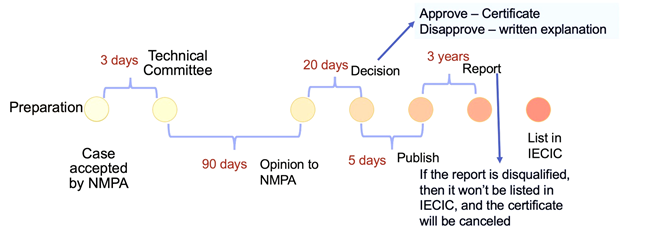
The application may take up to 4 months before a decision is made. The technical committee will need around 3 months to undertake the evaluation work.
Cosmetic Product Registration
The registration timeline of cosmetic products is the same as cosmetic ingredients registration. But the submission documents are different. For cosmetic products registration, applicants need to prepare:
- The name, address, and contact information of the registration applicant filing person and manufacturer.
- product name, formula, or full product ingredients.
- Standards implemented by the product.
- Product label sample.
- Product inspection report.
- Product safety assessment data.
- Registrant qualification
Label Requirements
For imported cosmetics, they must be labeled in Chinese and contain the following information:
- Product name, special cosmetics registration certificate number
- The name and address of the registrant, recorder, and entrusted production enterprise
- Cosmetic production license number
- The standard number of the product
- All ingredients
- Net weight
- Use period, method of use and necessary safety warnings
Annual Reporting
CSAR also introduces the annual reporting requirements. Applicants should submit the annual report of cosmetics from January 1 to March 31 each year.
- Basic information and production of new cosmetic ingredients.
- Information on cosmetic registrants, filers, or entrusted manufacturers who use new raw materials to produce cosmetics.
- Information on cosmetics using new raw materials, including product name, product registration or filing number, number of products produced or imported, sold, etc.
- Sampling inspection, investigation, and recall of cosmetics produced with new raw materials.
- The adverse reaction monitoring system, statistical analysis of adverse reactions, and measures of cosmetics produced with new cosmetic ingredients for cosmetics manufacturers.
- Risk monitoring and evaluation management system and measures of cosmetics produced with new cosmetic ingredients for cosmetics manufacturers.
Sectors
Content
Downloadable Content
- Mee Order 12 China REACH Actionable Summary
- Agrochemical Regulation Actionable Summary
- Food Contact Material Actionable Summary
- Medical Device Regulation Actionable Summary
- Cosmetics Actionable Summary
- Annual Regulatory Summary 2022 - China
- Law On The Prevention And Control Of Environmental Pollution By Solid Wastes-Chinese
- Work Safety Law Of The People’s Republic Of China-Chinese
- Law On The Prevention And Control Of Atmospheric Pollution-Chinese
- Environmental Protection Law Of China-Chinese
- Regulations On The Safety Management Of Hazardous Chemicals-Chinese
- Regulation On Pesticide Administration-Chinese
- Regulations On The Supervision And Administration Of Cosmetics-Chinese
- Measures For The Environmental Management Registration Of New Chemical Substances-China
- Inventory Of Existing Chemical Substances In China IECSC-Chinese
- Catalogue Of Hazardous Chemicals 2015 Edition-Chinese
- Guidance On The Compilation Of Safety Data Sheets For Chemical Productsgb/t 17519-Chinese
- General Rules For Preparation Of Precautionary Labels For Chemicals15258/2009-Chinese
- Specification For Classification And Labelling Of Chemicals GB30000-Chinese