


South Africa Pesticide Regulation
Legal Basis and the Authority
The Department of Agriculture, Forestry and Fisheries (DAFF) is responsible for the registration of pesticides in South Africa. Pesticides are regulated under the Fertilizers, Farm Feeds, Agricultural Remedies and Stock Remedies Act, 1947 (Act No. 36 of 1947). In June 2019, after the reconfiguration of government departments, the agriculture function of DAFF was substituted by the Department of Agriculture, Land Reform and Rural Development.
Overview
Fertilizers and Farm Feeds Parliament approved the Agricultural Remedies and Stock Remedies Act in 1947, which regulates pesticides and their use, among other things. The Act has been changed several times since then, but it has never been comprehensively overhauled. Since the Act's establishment, the operations of the Department of Agriculture, Forestry, and Fisheries (DAFF), the entity that administers it, have not been subjected to public scrutiny. Furthermore, many of the over 3000 pesticides licensed for use in South Africa have not been re-evaluated in years.
The objectives of this Act are:
- To improve the legislative framework and ensure that South Africans are better protected from health and environmental risks posed by pesticides.
- To encourage the development and use of alternative products and techniques and reduce dependence on chemical plant protection products.
- To integrate relevant international agreements and initiatives from other government departments.
- Increased transparency, access to information and improved public participation in the registration of pesticides.
Who can register?
To register a pesticide product in South Africa, the applicant company must have a local legal entity to represent them.
A legal entity might be a person or a firm registered with the Department of Trade and Industry under the Company Act.
Pesticides are only allowed to be registered if they are approved to be effective, safe, and of high quality.
For oversea manufacturers, they should appoint an Authorized Representative (AR).
Registration
Registration consists of the following steps:
- Five batch analytical reports are used to verify chemical and toxicological equivalency.
- Data from a GLP (Good Laboratory Practice) approved independent laboratory is required.
- Details about the production.
- At least three biological efficacy data reports on local cockroach species have been completed. The South African Bureau of Standards (SABS) conducts such research in South Africa.
- The active ingredients and the formed product's chemical-physical data must also be submitted. All product specifications, such as data on storage stability, must be submitted.
- Details about how the product works, including the method of action.
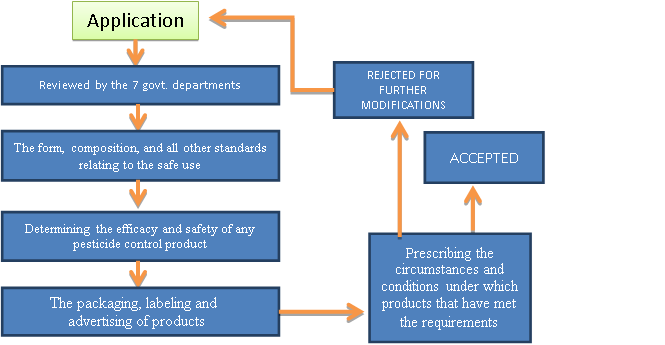
Labelling
The Department of Agriculture, Forestry, and Fisheries (DAFF) is responsible for ensuring that pesticides are appropriately labelled and that all information necessary for safe use is prominently displayed. Information should be given in such a way that a person can grasp the risks and acquire a sense of proportion to make an informed decision about whether those risks are acceptable. The labelling policy would be in line with the new Globally Harmonized System (GHS) of chemical classification and labelling.
Toxicity
The words "POISON EXTREMELY TOXIC" must appear in red letters no smaller than half the size of the product's name on a contracting background on the main panel of the label and the skull and crossbones; the second group requires the word "POISONOUS," and the third group requires the word "CAUTION" in a similar print. The least dangerous group does not require any toxicity information, but any indication that a product is possibly safe is permitted on the label or in promotional materials.
Toxic pesticide labelling is also subject to the regulations outlined in health law.
Compliance Strategies
GPC can help you with:
- Identification of compliance requirements under various guidelines including all data requirements.
- Data gap analysis and pre-assessment support
- Technical documentation support
- Pre and post-submission support and technical liaison with authorities.