


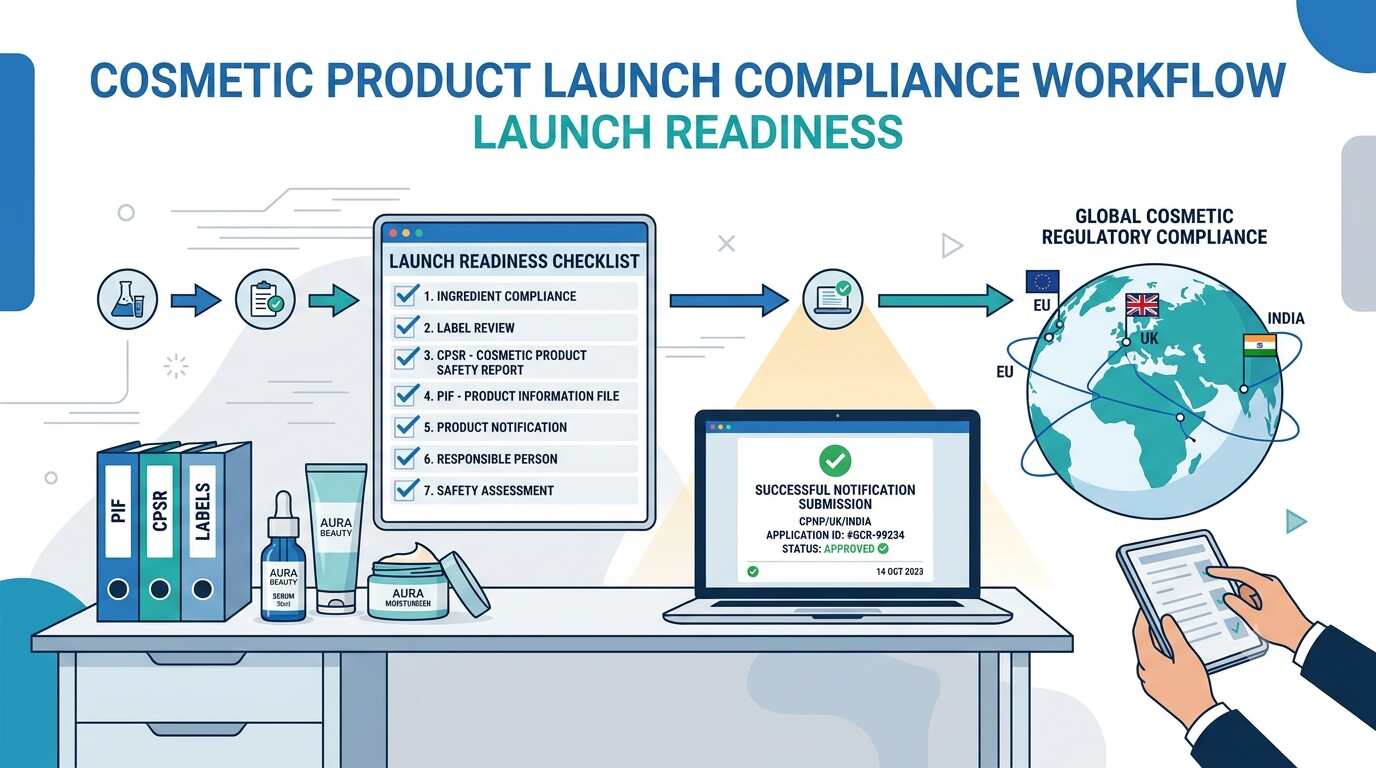
The Ultimate Checklist for Cosmetic Product Notifications
Launch Cosmetic Products Worldwide – No Delays, No Rejections, Low Costs!
Cosmetic products launching today are more than just a novel formula and attractive packaging prior to launch in stores of retailers or by way of online shops of such retailers.
Many companies still think that a product notification is simply an online registration.
Many people think that submitting the online form for product notification is all there is to it. Unfortunately, most countries require a lot of detailed technical documentation to be uploaded, as well as copies of all labeling, a list of all ingredients which have been confirmed to be safe for cosmetic use, and a description of all relevant and applicable market legislation.
A single document that is missing or an incorrectly declared ingredient could result in weeks of delay for your product launch or even prevent it from entering the market altogether.
This checklist will help you to prepare for the product notifications in time for the launch of cosmetics on the market.
Why Cosmetic Product Notifications Matter
Notifications on cosmetic products allow to recognize products which have been put on the market by the respective authorities and are under market surveillance in case of potential risks.
While submitting the online notification itself takes only a few minutes, weeks can pass until regulatory experts have prepared all necessary steps for the online submission of the notification.
A number of issues are typically discovered by a company whilst they are going through the process of notification of a product for release onto the market, such as:
-
Missing safety assessments
-
Incorrect INCI names
-
Unsupported product claims
-
Incomplete formulation details
-
Missing Responsible Person information
-
Non-compliant labels
Delays to launch and additional costs to bring a product to compliance are typical results of these types of problems.
The Ultimate Cosmetic Product Notification Checklist (2026)
1. Confirm Which Markets Require Notification
The first question isn't "How do I notify?"
It's:
Does this country require notification, registration, or both?"
For example:
|
Market |
Typical Requirement |
| European Union | CPNP Notification |
| United Kingdom | SCPN Notification |
| India | Import Registration (where applicable) |
| GCC Countries | Country-specific notification/registration systems |
| ASEAN | Requirements vary by country |
Every market follows different procedures.
When launching in many countries, each country will have its own set of procedures that must be followed.
2. Verify Every Ingredient Before Submission
Many last-minute reformulations are the result of compliance issues with certain ingredients prior to notification.
-
Are all ingredients permitted?
-
Are any ingredients restricted?
-
Are concentration limits exceeded?
-
Are preservatives compliant?
-
Are UV filters authorized?
-
Are colorants approved?
-
Are fragrances subject to allergen declarations?
-
Does the formulation contain nanomaterials?
Don't rely solely on supplier statements.
Each target market applies its own regulatory restrictions.
3. Use Correct INCI Names
Cosmetic ingredients have to be listed with the correct International Nomenclature of Cosmetic Ingredients (INCI) name when being checked by authorities.
Common mistakes include:
-
Trade names instead of INCI names
-
Outdated ingredient names
-
Misspelled botanical ingredients
-
Incorrect fragrance declarations
Even small naming errors create unnecessary regulatory questions.
4. Complete the Safety Assessment
Most cosmetic products cannot be notified until a qualified safety assessment for that specific product has been completed.
-
The assessment should consider:
-
Toxicological profile
-
Exposure calculations
-
Margin of Safety (MoS)
-
Intended use
-
Target population
-
Product category
Releasing the cosmetic product first and then preparing the safety assessment documentation later can result in severe compliance risks.
5. Prepare Your Product Information File (PIF)
A majority of companies only start to think about the PIF when authorities suddenly request it in the context of a market placement.
A PIF should contain all relevant information for a cosmetic already before the market placement of this product by a company is started.
A well-prepared PIF generally includes:
-
Product description
-
Formula
-
Manufacturing information
-
Safety assessment
-
Stability data
-
Packaging information
-
Label artwork
-
Claims support
-
Supporting technical documentation
-
Think of the PIF as your product’s regulatory passport.
6. Review Product Labels Carefully
Labeling errors are the most frequent type of observed deviations by authorities during inspections.
Before notification, confirm:
-
Ingredient list is correct
-
Mandatory warnings are included
-
Responsible Person details appear correctly
-
Country-specific language requirements are met
-
Batch number is present
-
Nominal content is correct
-
Include Period After Opening (PAO) or expiry date on the label.
Function of the product is clear
Remember:
Additionally, check online product pages for compliance with the relevant requirements.
7. Verify Cosmetic Claims
By the time the marketing department comes up with a claim relating to cosmetic products the relevant information and supporting data will have been scrutinized by the regulatory department.
Examples include:
-
"Dermatologically tested"
-
"Hypoallergenic"
-
"Natural"
-
"Clinically proven"
-
"Organic"
-
"Preservative-free"
Each claim should be supported by appropriate evidence.
These types of statements could potentially attract the attention of regulatory bodies or be considered as being misleading to consumers.
8. Confirm the Responsible Person (or Equivalent)
In many countries the Responsible Person for cosmetics has to be a fixed body (e.g. company, department).
Before notification, verify:
-
Responsible Person has been appointed.
-
Legal address is correct.
-
Contact details are accurate.
-
Responsibilities are clearly documented.
Later changes to the Responsible Person will require updates to the Regulatory Authorities.
9. Gather All Information Necessary for Online Notification Submission.
The online notification process is often initiated by companies without having all the required information at hand.
Prepare in advance:
-
Product name
-
Product category
-
Formulation
-
Packaging images
-
Label artwork
-
Manufacturer information
-
Responsible Person details
-
Country of manufacture
-
Nanomaterial information (if applicable)
Having everything ready significantly reduces submission errors.
10. Plan for Post-Market Compliance
Once a company has completed its pre-notification activities and completed its notification it does not mean that all regulatory obligations cease.
After launch, companies should continue to:
-
Monitor adverse events
-
Report Serious Undesirable Effects (where required)
-
Update documentation after formulation changes
-
Monitor regulatory changes
-
Review labels periodically
-
Maintain technical documentation
-
Support inspections and authority requests
-
Notification is the beginning of compliance—not the end.
Common Mistakes Companies Make Before Product Notification
Many errors are based on enforcement experience of cosmetics legislation.
-
Assuming one notification covers every country
-
Using supplier documentation without independent verification
-
Completing labels before reviewing regulations
-
Delaying safety assessments until just before launch
-
Forgetting to update documentation after formulation changes
-
Not treating a notification as part of a complete compliance strategy for a product.
A Practical Example
To illustrate the complexity of compliance within individual processes, the same facial serum product example is used to outline how a single product goes through different processes for Cosmetic Product Notification.
The formulation of your product is identical across all countries for which you want to launch your product so you assume that one package of documents will be sufficient for all countries.
However:
-
The EU requires CPNP notification and an EU Responsible Person.
-
UK: Responsible Person for the UK and SCPN notification.
-
India requires imported cosmetics to comply with the requirements of CDSCO and in addition adequate documentation to support marketing in the local market must also be in place.
The product does not change but the way to get it on the market does.
Even the smallest changes to a product can cause significant problems if notification has not been done properly and companies identify the problems early on in the process of getting a product ready for launch they can save a lot of time and avoid unnecessary problems.
Need Help with Cosmetic Product Notifications?
We are here to help Cosmetic companies, Manufacturers, Importers and Distributors of cosmetic products with all their needs regarding the regulatory compliance of their products.
-
Cosmetic Product Notifications (CPNP, SCPN, and other jurisdictions)
-
Cosmetic Product Safety Reports (CPSR)
-
Product Information File (PIF) preparation
-
Ingredient and formulation compliance reviews
-
Responsible Person (EU/UK) services
-
Labeling and claims assessments
-
Global cosmetic market entry strategies
-
Post-market regulatory support
Final Thoughts
Cosmetic product notification is more than the online submission of a single document. It is the last step in a complex process of cosmetic regulations of ingredients, of safety assessments for new products of the company, of preparation of technical dossiers, of labeling and of all post-market control measures of a company.
Cosmetic regulations are constantly evolving. For 2026 and there after it is crucial for companies to start planning the notification of their cosmetics on the market in time to gain timely market access and to avoid potential compliance problems whilst maintaining consumer trust.
Whether you are launching a single cosmetic or a whole range of cosmetics across the globe, a well-structured notification strategy is crucial for successful market introduction in time and without costly delays.