


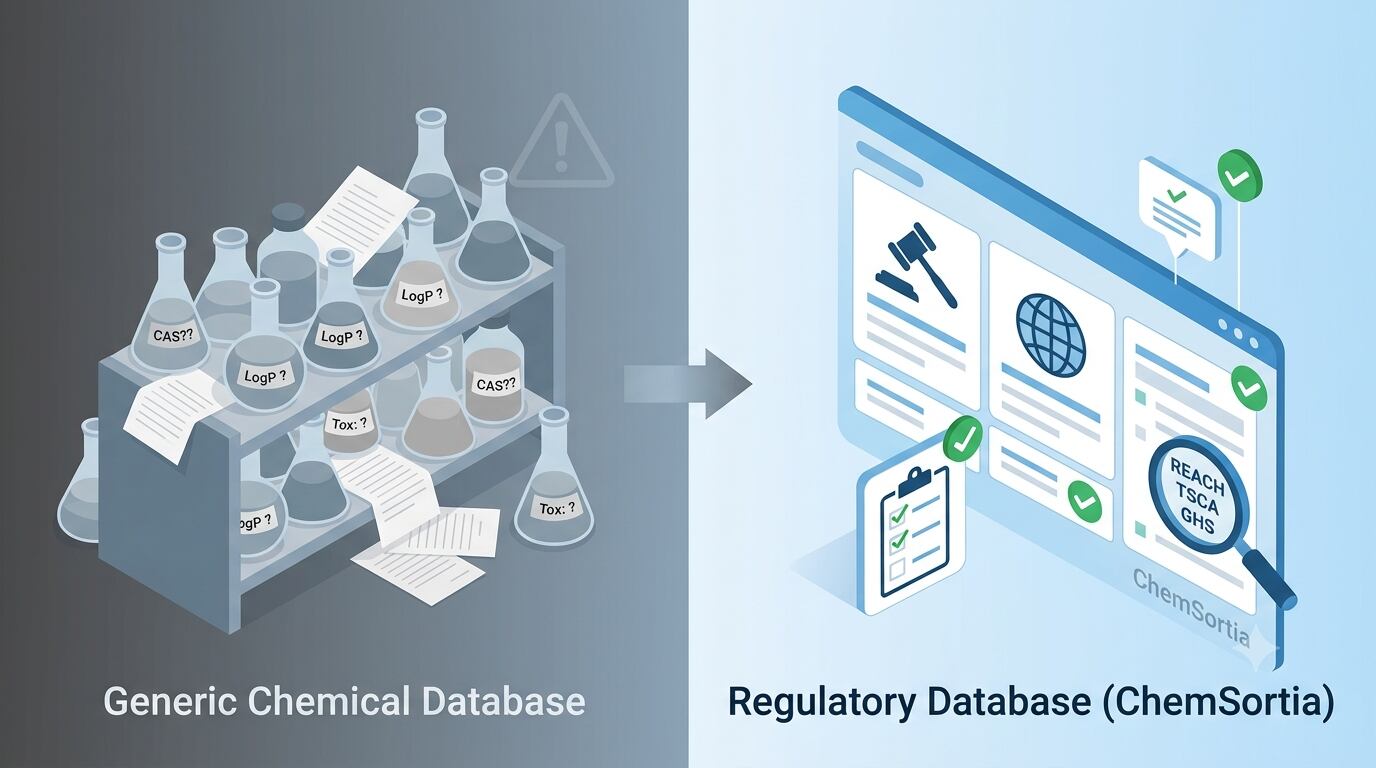
Chemical information is not created equal. Information can help formulate chemists, information can help Supply Chain managers, and information can help people in Regulatory affairs avoid big problems with product launches. This post contrasts ChemSortia with “generic chemical databases” with examples of databases for chemical information, and describes why ChemSortia is distinct from these generic databases.
Here’s a comparison of common generic chemical databases and specialized “chemical regulatory databases” for chemical information like ChemSortia. By the end of this article, you will know what type of database you need and for what purposes a more specialized “regulatory database” is needed as opposed to a generic purpose chemical database.
Generic chemical databases are large chemical databases with a very broad scope of chemical information such as PubChem, ChemSpider, or even just spreadsheets in Excel or similar format which have been compiled from public data sources. The typical information that such databases store about a chemical are its:
Basic identifiers (CAS number, name, formula)
Physicochemical properties (melting point, logP, molecular weight etc.)
2D/3D structures
Some kind of hazard classification (very limited and mostly aggregated into a single score or even just into three groups: toxic, non-toxic, unknown).
Information within the databases of generic chemical databases is compiled from a wide variety of contributors. The data found within the databases of chemical information, such as PubChem, are very good for a scientist that is conducting research, for the chemist who is in the initial development of a chemical, for the student that is studying chemistry as the basic facts of any chemical are found in these databases to complete assignments for school. The information provided by databases of chemical information are generally free and very good.
They lack complete data, timely updates and relevant information from official sources, such as regulatory lists. Furthermore, such databases typically lack information on relevant regulations for a specific data point and it is often not clear whether a certain hazard classification is binding or not.
A Regulatory Database contains information on chemical substances of interest to organizations. They require to know the facts about the chemicals they are handling and about which they are being asked to take responsibility. Such information is provided by a specialized Regulatory Database, for example ChemSortia. As opposed to a generic chemical information database (or ‘database’), the data in a Regulatory Database is organized in a manner appropriate for the user of such information.
Official lists of regulated chemicals (published by governments or international organizations), e.g. EU REACH (Annex I lists), TSCA, CLP, GHS, …
Legal statuses (restricted, prohibited, exempted, candidate list)
Exposure and risk-based classifications (e.g. OELs for occupational exposure, consumer exposure limits etc.)
Data has been traced back to the source, such as a regulation, annex, official publication, etc. from which the information was derived.
The databases contain data on the regulation of a chemical in various jurisdictions, for example in the EU, in the US and in China.
In short, a regulatory database answers questions like:
“Is this substance allowed in cosmetics in Japan?”
“What is the exact SVHC threshold under REACH?”
“Has this chemical been notified under K-REACH?”
Generic databases cannot reliably answer those questions.
|
Feature |
Generic Chemical Databases |
ChemSortia (Regulatory Database) |
|
Purpose |
General information on chemistry |
Information on safety and on the regulatory compliance with the laws of several countries relating to chemicals |
|
Data sources |
Mixed (e.g. Journals, Patents, User-Contributed Data) |
From official sources (e.g. Laws, Annexes, Regulatory Lists) |
|
Cosmetic regulation status |
Not included |
Information about the status of the substance within the framework of Cosmetic Regulations in various countries (e.g. Is this substance allowed in cosmetics in Japan?) |
|
Update frequency |
Inconsistent |
Tracks regulatory changes (often real-time) |
|
Hazard classification |
Information on hazard classification according to GHS is available, but mostly not sourced |
Hazard classification according to GHS (Sourced) |
|
CSV export / API |
Basic CSV / API export of chemical data |
Compliance reports and SDS authoring support |
|
Auditability |
Not suitable |
Fully auditable (including source citations and date stamps) |
|
Cross-jurisdiction compare |
Manual effort |
Built-in |
Unlike generic databases for chemistry information that contain numbers on the chemical’s regulations such as ECHA’s Candidate List for substances of very high concern, ChemSortia – the chemical information regulatory database for researchers and professionals – embeds the chemical’s regulatory context as the main feature.
Using a generic chemical database for a project that requires regulatory certainty can expose a company to considerable risks.
Substances are listed in the generic chemical database as not restricted under REACH even though they have been added to an annex of the REACH regulation in the meantime.
Many generic chemical databases simply merge the information of many countries without highlighting the important differences of the jurisdictional regulations. For example, a chemical could be a TSCA chemical in the US but a POPs Regulation banned the chemical in the EU. A search on a generic chemical database for information on a TSCA chemical would not note any restrictions for this chemical in the EU.
Auditors and customers would like to have evidence that the products comply with the local legislation. A generic database is not able to provide sufficient evidence to trace back to a valid source of information. ChemSortia on the other hand records the relevant excerpts of the legal text and the date.
In addition, the information from generic chemical databases are often aggregated, which can result in less accurate information. Thus, a substance identified as an eye and/or skin irritant with a level of 2 may be a “Skin Sensitizer 1B” in accordance with official EU CLP notifications. Incorrect declaration of the Safety Data Sheets (SDS) and of the labeling of the product can result, which in turn can constitute a contravention.
A generic database might exclude a substance that is listed on the Candidate List for Possible Substitution of SVHCs. However, this same substance may also be listed on the REACH Authorisation List and have completely different legal requirements. ChemSortia will list both Candidate List and Authorisation List information for the same substance and explain the legal distinctions in detail.
You are a student or academic researcher exploring basic chemistry.
You need preliminary property information (boiling points, solubility etc.) for a new chemical synthesis that ChemSortia doesn’t yet have data on.
You are building a chemical catalog and, for this reason, you want to create a first broad inventory of chemicals and their properties.
You are not exporting or manufacturing products subject to chemical control laws.
You manufacture, import or formulate and then sell chemicals in regulated markets like EU, US, China, Japan, South Korea etc. – whether or not in or exported from your home market.
Formulators, who compile Safety Data Sheets (SDS) or product labels.
You need to answer questions like: Is this substance even authorized for sale in this country?
Preparation of regulatory submissions (e.g. REACH registration, TSCA section 5 notification, K-REACH pre-registrations etc.).
Customers must be fully informed of all relevant information and the organization must be able to keep a full audit trail of all distribution.
You manage a restricted substance list for supply chain compliance (Restricted Substance Lists – RSL).
While some companies work only within a restricted framework of starting from a generic database for chemical identification and then proceeding to decisions on chemical regulation by using a specialized database, others work through a whole range of steps from a generic database to a dedicated database such as ChemSortia.
Generic chemical databases can be good for the purposes of broad chemical information, but they are not intended to be used as chemical regulatory databases. There are legal, financial and even business-destroying risks to using a generic chemical database for chemical regulatory information.
Our tool ChemSortia is the authoritative chemical regulatory database that bridges the chemical knowledge gap for compliance. An up-to-date, information system that is fully jurisdiction-aware, ChemSortia supports its users in complying with chemical regulations around the world. We therefore include information on REACH and TSCA as well as on country-specific chemical inventories, on GHS classification and labeling requirements, etc. All information is provided in a fully traceable and actionable manner.
Ready to see the difference?
Explore ChemSortia today:
https://chemsortia.conformics.com/
See where the risks hide! Compare a generic chemical database against ChemSortia – the world’s leading chemical regulatory database – by requesting a demo or trial today. As the primary tool for any organization wishing to reach informed decisions in chemical compliance and to have the all-important evidence of their due diligence to support them should they be audited, ChemSortia is the market leader.
If you want to access the GHS report, please Register here in GPC Intelligence Portal click here