


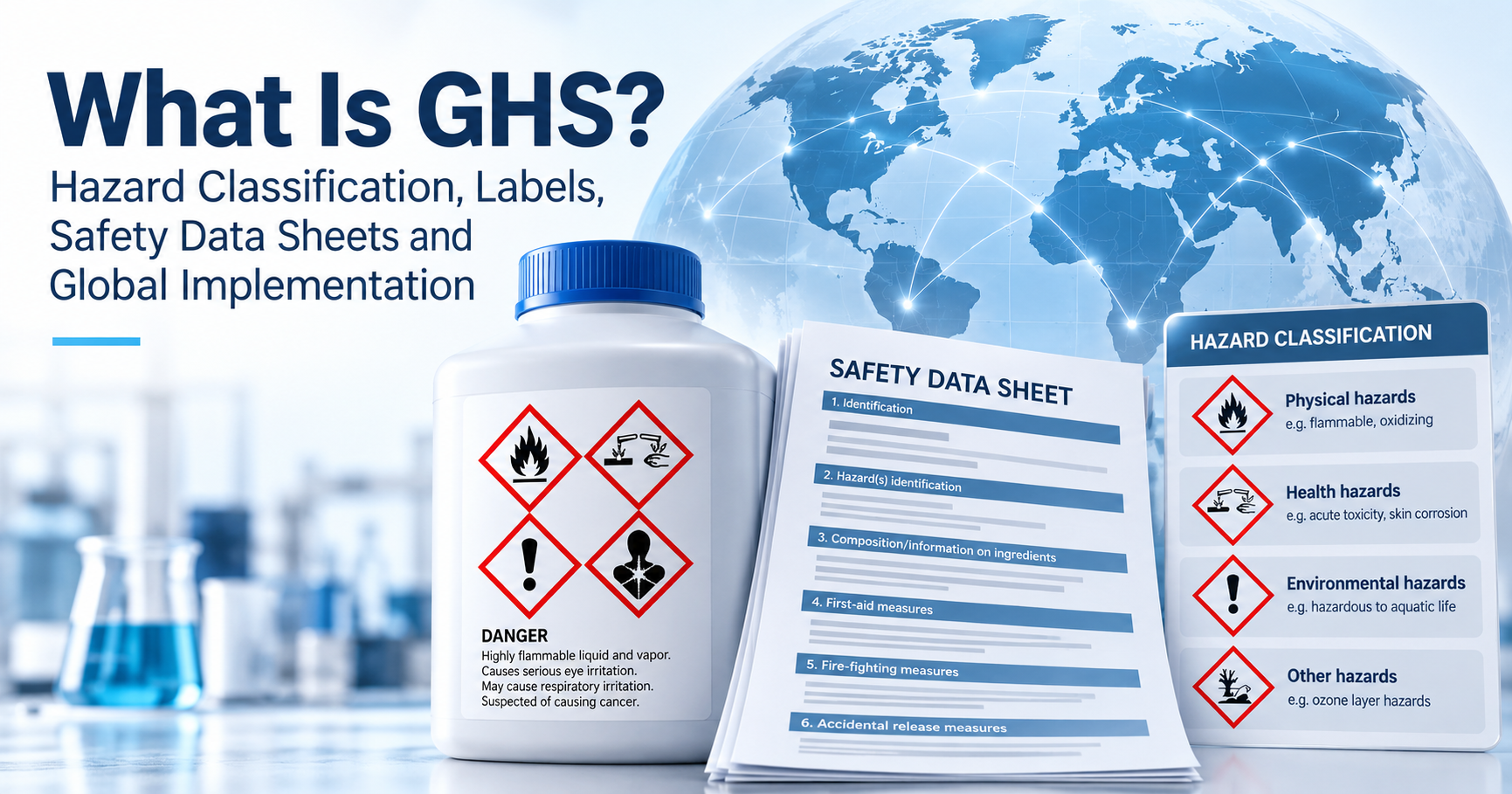
What Is GHS?: Hazard Classification, Labels, Safety Data Sheets and Global Implementation
GHS stands for Globally Harmonized System of Classification and Labelling of Chemicals. It is a system for the classification and communication of hazards of chemical substances and mixtures developed by the United Nations. Its requirements need to be met by businesses in all markets where they supply products. [1]
The Guide answers following questions for manufacturers, importers and exporters of chemicals: How to classify chemicals? Which Hazard Statement and Pictogram(s) to use for labeling? Does the SDS comply with requirements of the importing country?
This guide covers GHS classification, signal words, hazard statements, Safety Data Sheets (SDS) and their implementation across the world. We also discuss issues relevant to companies based in India supplying chemicals across the globe.
What does GHS stand for and what does it mean
The full name of GHS is Globally Harmonized System of Classification and Labelling of Chemicals. The aim of GHS is to provide consistent and clear information on the hazards of chemicals to supply chain partners.
A hazard is an intrinsic property that can cause harm, such as a chemical’s flammability or its potential to cause skin corrosion. The risk of a chemical causing harm, however, also depends on the extent to which it is exposed, and the conditions under which it is used. The GHS classification of a chemical deals with the hazard(s) that it presents.
Who developed GHS and what is the Purple Book
The United Nations GHS was developed by countries joining forces to establish classification and communication of hazardous chemicals and pesticides through the GHS Purple Book.
The text here is updated as of October 2026. The UNECE states on its website that the current (eleventh) revised version of GHS was published in 2025 as the 11th revised edition (2025). Updated UN editions of the GHS do not automatically enter into force as legislation in all countries. Indeed, particular provisions of GHS can be adopted by authorities by legislation and there may be a transition period allowed before they come into force.
So, when you are reviewing an SDS or label look for the UN framework that has been adopted and the current legislation of the market on which you intend to enter and any transitional provisions that may apply.
Why is GHS important for chemical safety and trade
Before harmonisation different classification systems for chemicals had communicated the same chemical’s hazards in different ways. The GHS provides a framework for describing a chemical’s hazards and the required precautions by using consistent language and concepts.
Consistent terminology will aid workers in different locations when trying to understand information on products supplied by various manufacturers. Also it will help in case of emergencies or in downstream use, by giving a clear understanding of the hazardous properties of a chemical.
For a company it enables them to organize their product information in a better way. When doing a documented classification assessment it enables them to make labels, SDS’s and other customer information in a more adequate way. International suppliers of chemicals can easily see what parts of the information need to be changed for other markets then the one in which the information was originally created.
Who needs to understand GHS requirements
GHS is of relevance to manufacturers, formulators, importers, distributors, employers and other people dealing with chemicals. Their legal obligations however depend on country, product and activity.
Manufacturers and formulators require accurate information about the substances and mixtures they manufacture. Importers need to establish whether documentation received from elsewhere in the world will be acceptable under local legislation. Distributors need a system to pass on information to customers. Employers require information to fulfill specific workplace duties and may require their employees to be informed and/or trained in the use of safety information.
The exporter should clarify with the customer who is responsible for what prior to shipment of the goods. The responsibility for preparation of documents, provision of local contact address and discharge of import obligations may lie with different parties. Statutory obligations cannot be dispensed by agreement of the parties for commercial reasons.
What are the three main components of GHS
The three cornerstones of GHS are hazard classification, chemical labeling and Safety Data Sheets (SDSs). The hazard classification describes the danger posed by a chemical and how severe it is. The chemical labeling provides essential information with regard to hazards and precautions by means of pictograms, signal words, hazard statements and precautionary statements. The information in the SDS helps users to handle chemicals safely, to store them and to provide exposure control and emergency information. The information is necessary for safe use of the chemicals and for safe handling in the whole supply chain. [3]
How are physical health and environmental hazards classified
The physical, health and environmental hazards of a substance are assessed when classifying according to GHS. Flammability, acute toxicity and the hazards to the aquatic environment are examples of this.
A hazard class describes the type of hazard a substance or mixture may pose. The hazard categories represent the different classification levels within a hazard class and indicate the degrees of hazard within a classification.
Category numbers are interpreted within the frame of a particular hazard class and do not provide a cumulative safety score for the whole product. These numbers are not to be confused with the NFPA or HMIS ratings.
How does classification differ for substances and mixtures
A single substance is typically classified on the basis of relevant information regarding its properties and hazards. Mixtures are assessed by reference to available data on the mixture and/or by application of bridging principles or by assessment on the basis of the ingredients in the mixture, as appropriate.
Also the information with respect to the identity of the individual ingredients, their concentration in the mixture and the quality of the data with respect to the individual ingredients is important. A diluted form of an undiluted hazardous ingredient is not necessarily less hazardous. Many hazardous properties of an undiluted hazardous ingredient are not eliminated by dilution of the ingredient. [4]
Record the information considered, the rules applied and the reasoning behind the classification decision. Later this will help to assess changes to a formulation or changes in the relevant regulatory requirements.
What information belongs on a GHS aligned label
The chemical label contains the product identifier and supplier information and all elements required for hazard communication. These are the pictograms, the signal word, the hazard statements and the precautionary statements. The labeling elements are chosen after the classification has taken place and in accordance with the relevant labelling rules. [5]
The product identifier (PI) enables users to find the respective Safety Data Sheet (SDS). Supplier information has to comply with local requirements with regard to language, readability, packaging and any exceptions allowed for the market concerned.
The label should be designed following the classification assessment. To ensure that all required warnings are included, a familiar pictogram should be chosen first and the product labeled around it instead of the other way around.
What do the nine GHS pictograms mean
The GHS system includes nine hazard pictograms. Each can communicate several related hazards, so the short descriptions below are examples rather than complete classification rules. National systems do not necessarily require every pictogram for every sector.
| Pictogram | Examples of hazards communicated |
| Exploding bomb | Certain explosive and reactive hazards |
| Flame | Flammability and certain other fire hazards |
| Flame over circle | Oxidising hazards |
| Gas cylinder | Gases under pressure |
| Corrosion | Skin corrosion, serious eye damage or corrosion to metals |
| Skull and crossbones | Certain irritation and other health hazards |
| Exclamation mark | Certain irritation and other health hazards |
| Health hazard | Certain chronic or serious health hazards |
| Environment | Certain aquatic environmental hazards |
Select pictograms from the applicable classification criteria and precedence rules. The absence of a particular pictogram does not establish that a product
What are the two signal words under GHS
The two GHS signal words are Danger and Warning. The term Danger indicates more severe hazards than Warning, which is used for less severe hazards where a signal word is required.
A label can have only one signal word. For classifications that require Danger, Warning is not included on the label. For some classifications, no signal word is required so neither word would be added automatically.
What are GHS hazard statements
GHS hazard statements describe the nature of a hazard and, where appropriate, its degree. They have identifying codes beginning with H. A few examples are shown below.
| Code | Hazard statement |
| H225 | Highly flammable liquid and vapour |
| H315 | Causes skin irritation |
| H315 | Causes skin irritation |
| H319 | Causes serious eye irritation |
These examples are not a ready-made classification for a product. Select the statements assigned by the applicable criteria and use the prescribed wording in the required language. A code identifies a statement; displaying the code alone does not communicate its meaning to the user.
What are GHS precautionary statements
Precautionary measures to prevent damage. P-statement describes prevention measures and storage and disposal rules to limit possible harm caused by a chemical.
In many cases the warning (hazard statement) and the advice on how to avoid a hazard (precautionary statement) are presented separately. The relevant statements must be selected on the basis of the appropriate selection rules for the respective situation and product.
What is a GHS safety data sheet
A Safety Data Sheet (SDS) contains the necessary information to handle safely a chemical and to store it; to control exposures to it; and to deal with emergencies involving it.
The abbreviation MSDS stands for material safety data sheet. Using the title SDS (instead of MSDS) does not in itself make a document safe. Content, classification, design and compliance with local requirements have to be checked.
What are the 16 sections of an SDS
The internationally recognised SDS structure uses the following sequence. Exact information obligations and enforcement differ by jurisdiction. For example, OSHA specifies mandatory information for Sections 1–11 and 16, while its Appendix D treats Sections 12–15 differently.
| Section | Heading |
| 1 | Identification |
| 2 | Hazard identification |
| 3 | Composition and information on ingredients |
| 4 | First aid measures |
| 5 | Firefighting measures |
| 6 | Accidental release measures |
| 7 | Handling and storage |
| 8 | Exposure controls and personal protection |
| 9 | Physical and chemical properties |
| 10 | Stability and reactivity |
| 11 | Toxicological information |
| 12 | Ecological information |
| 13 | Disposal considerations |
| 14 | Transport information |
| 15 | Regulatory information |
| 16 | Other information |
Section 2 is particularly useful when checking consistency: compare its classification and label elements with the actual product label. Also review whether handling instructions, physical properties and transport information are consistent with the product data.
What does GHS look like in practice
For an example solvent product, which has been classified as Flammable Liquid Category 2, a suitable label would contain the flame pictogram and the word ‘Danger’ followed by H225 and Highly flammable liquid and vapour.
In addition to the hazard characteristic the product must also include product trade name, supplier name and address with any appropriate additional warning(s) for the product. The SDS Section 2 must include the same classification and label information as the product label. The other sections must contain appropriate information with respect to handling and storage, exposure information and in case of accidental release, emergency information.
This example describes one type of hazard only, but a solvent formulation can contain many other hazards like eye, skin, or aspiration hazards. A generic example like this one cannot replace a complete hazard assessment and classification of a product, which also needs to consider the respective label.
How is GHS implemented around the world
GHS is implemented through national and regional systems and by building blocks of provisions that can be selected by authorities for the sectors and audiences they are responsible for. Resources for implementation are published by UNECE. However, country requirements must be verified against the most current national sources. [2, 8]
Therefore, the GHS status of a country is much more useful for a detailed market analysis than the simple statement adopted or not adopted. Important are the criteria that have been adopted, the sectors that are covered, the languages that are used and the transition arrangements.
How do GHS requirements differ between countries
| Section | Heading | Practical consideration |
| European Union | Classification Labelling and Packaging Regulation | Apply EU CLP requirements and assess EU SDS obligations separately under REACH. |
| United States | OSHA Hazard Communication Standard | Check the applicable HCS requirements and revised compliance dates. |
| Canada | WHMIS and Hazardous Products Regulations | Check supplier requirements under the amended regulations and workplace duties. |
| China | Applicable GB classification and labelling standards | Identify the relevant standards and required Chinese documentation. |
| India | Applicable hazardous chemical rules and relevant standards | Assess product and activity scope, plus the requirements of export destinations. |
Note: EU CLP is a GHS-based provision in the EU legal system and should not be confused with the UN document. [4]
The OSHA 2024 HCS update aligns primarily with GHS Revision 7. OSHA extended the compliance dates for the update in January 2026. Therefore, these updated summary dates are no longer accurate and businesses should verify current compliance dates for implementation. [9]
The transition period for the amended Hazardous Products Regulations in Canada ended on December 14, 2025. For suppliers of hazardous products, an assessment of the amended requirements for their products is recommended. [10]
Standards for product classification and labeling on the Chinese government’s official portal for standards are listed as GB 30000.1-2024 General principles of classification and labelling and GB 15258-2009 Chemical safety signs. It is important to verify whether other standards exist for a particular product and their current status. [11]
What should businesses know about GHS implementation in India
Implementation of GHS in India starts with identification of chemical, industrial activity and transaction. As already mentioned the Manufacture, Storage and Import of Hazardous Chemical Rules, 1989 contain safety information provisions in Rule 17 and Schedule 9 safety data sheet format. [12]
Just because someone says a document is ‘GHS compliant’ doesn’t mean it complies with all the relevant Indian rules, standards and industry-specific obligations in relation to a particular transaction or activity.
For an Indian exporter, the assessment to determine whether an SDS needs to be amended when supplied to a foreign buyer for use in another country will depend on the classification of the chemical as well as the contact details and language used in the SDS. It is wise to seek confirmation from the importer as to the specific local requirements at the earliest stage in the supply chain.
How can businesses implement applicable GHS requirements
Use this Workflow for organizing a Product Review. It is a starting point which can be adjusted to the markets and products that are relevant to you.
1. Who are your markets and what are the roles and responsibilities of the parties involved? Where does the product come in and who is the manufacturer, importer, distributor – and end-user?
2. Collect correct product data. This comprises the composition, the correct name of all ingredients, their exact concentration, relevant studies on the product and the current documentation from the supplier.
3. Assess classification according to the applicable legal criteria for the respective markets and record the decisions with corresponding justification.
4. Complete or update the Safety Data Sheet (SDS). Ensure all necessary information and language is included along with proper contact information and supporting documentation.
5. Prepare Label and review for completeness of all required elements such as product identifiers, required safety and warning pictograms, additional warning statements, etc.
6. Workplace Use – make Safety Information available and address required training and operational controls as required by the relevant workplace legislation.
7. Revision control. Identify the responsible person to review newly identified hazards, changed formulations, or relevant amendments to legislation.
For larger product portfolios, it can be helpful to set up a matrix to show approved versions of Safety Datasheets and Product Labels for each product on offer in different markets. This ensures that you never accidentally send out an outdated version with a new consignment of product.
What common GHS compliance mistakes should businesses avoid
Inconsistency between product label and SDS Section 2 is another very common error. Reviewing the product label and the SDS Section 2, in particular after a change to a formula or update of a classification, will often expose errors of this type.
Using an SDS written for distribution in one country to meet the regulatory requirements in all countries where it is exported. Again, translation of the SDS is not enough to take into account the fundamental differences in the underlying legislation – classification and other content must also be reviewed.
A number of errors occur due to statements from an entirely different product having been incorporated into the SDS, failure to include relevant mixture data in the SDS and the incorrect assumption that the most recent edition of the UN guidelines is currently mandatory in every country worldwide. The errors can be easily avoided by linking product evidence with market requirements and having these updated simultaneously.
Frequently asked questions about GHS
Is GHS legally mandatory?
GHS is an international framework that can be governed by National or Regional rules. What are the legal requirements for your products going to the Market you are selling to? What are the requirements for your role in the Supply Chain? [2]
Does one GHS label work in every country
You should not assume that a label will comply with the requirements of all countries to which you distribute a product. In particular, countries may use different criteria to determine required hazardous substances or products, and may require supplementary information or additional language on the label. It is best to verify compliance with the requirements of each country to which you distribute a product before using a proposed label on shipments to several countries. [8]
Are GHS labels for hazardous products and dangerous goods transport labels the same?
Workplace/Supply Labels and Dangerous Goods Transport Labels are two different things and are governed by different systems (i.e. chemical hazard communication and dangerous goods transport). A single label that is used for workplace/supply communication does not replace the transport assessment and associated marking, labeling and documentation required for transport of the same product. [8]
Where should GHS label elements appear?
Pictograms, the signal word and the hazard statements for a hazardous chemical or product must be grouped together on the label and remain readable and relevant to the specific container(s) to which the label is applied. [6]
How often should an SDS be updated?
You must follow the market requirements regarding update periods for an SDS and an assessment of the content regarding hazard information, composition, use and legal requirements. It must also be possible to trace back the updates. This does not have to be with a fixed date.
How GPC can support chemical classification SDSs and labels?
As a globally operating business supplying chemicals in markets worldwide, accurate product data and an understanding of the regulations applying in all countries and markets are critical to you and your business. Global Product Compliance supports companies with the chemical classification of their products as well as with the creation and check of SDSes and labels for all relevant countries and markets.
Contact GPC: https://gpcregulatory.com/contact-gpc/ to review the specific requirements of your product, the role of each party within your supply chain and the countries in which you intend to supply.